
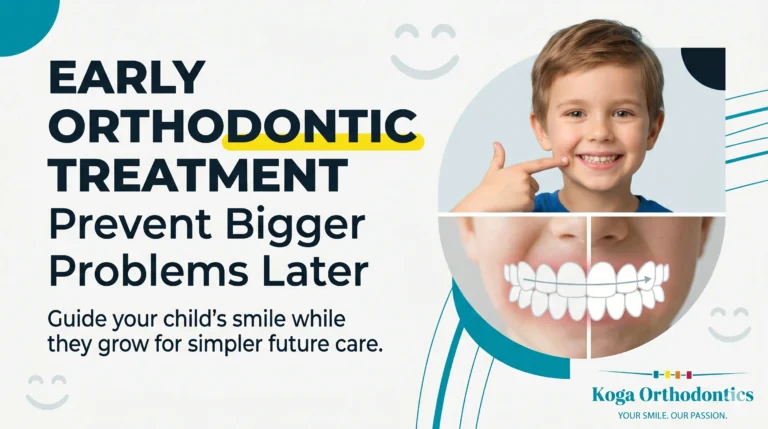
Seeing an orthodontist early can help avoid more invasive treatment later because some bite and jaw problems are easier to guide while a child is still growing. That does not mean every child needs braces early. It means an early evaluation — with an orthodontist who focuses on children and teens in Monroe and West Monroe, LA — can show whether a small issue should be monitored, treated now, or watched until the timing is better. In some cases, that early guidance can reduce the chance of more complex treatment later, including extractions or surgical correction.
For many parents, the biggest benefit of an early orthodontic visit is not starting treatment right away. It is understanding what is developing and whether there is a better time to address it. When problems are identified early, treatment is often more flexible, more conservative, and easier to plan.
Why does early orthodontic timing matter?
Orthodontic timing matters because children are still growing. Their teeth are changing, their jaws are developing, and their bite is still taking shape. That growth gives orthodontists an opportunity to guide certain problems before they become more established.
Once growth is further along, some issues can become harder to correct with simple orthodontic treatment alone. A narrow upper jaw, an uneven bite, or a jaw relationship problem may be easier to address while the bones are still developing. If those same issues are left untreated for too long, treatment can become more complicated later.
This is why early evaluations matter. They help determine whether there is an ideal time to act instead of waiting until a problem becomes more severe and more difficult to manage.
Does an early orthodontic visit mean early braces?
No. This is one of the most common misconceptions parents have. Most children who come in for an early evaluation do not need immediate treatment. In many cases, the recommendation is simply to monitor growth and come back at a later stage.
The American Association of Orthodontists recommends that children have their first orthodontic evaluation by age 7. At that point, enough permanent teeth have come in that an orthodontist can get a clear picture of how the bite is developing — even if treatment is still years away.
An early evaluation at Koga Orthodontics gives families in Monroe and West Monroe a starting point. It is not a commitment to braces. It is a way of knowing what to expect and when to act.
What kinds of problems are easier to treat early?
Some orthodontic problems respond especially well to early intervention because treatment can work with the body’s natural growth. These include narrow palates that benefit from palate expansion, crossbites that cause the jaw to shift, significant crowding that may worsen as more permanent teeth erupt, and certain bite patterns involving the upper and lower jaws.
Early treatment — sometimes called Phase 1 orthodontic treatment — is not used for every situation. But in the right cases, it can simplify or shorten what would otherwise be needed in adolescence or adulthood. (For more on what Phase 1 treatment involves and when it’s recommended, see our related guide on Phase 1 orthodontics.)
How can early treatment help avoid more invasive care later?
When growth is on your side, orthodontic treatment can often guide the jaw and dental arches in a direction that reduces the severity of the problem. That is really the goal: not to do more treatment earlier, but to make future treatment more manageable.
In some cases, addressing a problem during growth means a patient may still need braces later — but the overall treatment may be shorter, less involved, or less likely to require permanent tooth removal. In other cases, early treatment may prevent a bite problem from progressing to a point where surgical correction becomes necessary.
Can early orthodontic care reduce the need for extractions or surgery?
Sometimes, yes. When orthodontic problems are identified while a child is still growing, there may be opportunities to guide bite and jaw development in a way that reduces the severity of the problem later. That can sometimes lower the chance of needing extractions or jaw surgery in the future.
This is especially important in cases involving jaw imbalance, severe crowding, or bite patterns that tend to worsen over time. The earlier those patterns are recognized, the more likely it is that treatment can focus on guidance rather than correction after the problem has fully developed.
That said, every child is different. Early care does not eliminate every risk, and it is not the right choice in every case. The real value is understanding whether growth can still be used in the child’s favor.
What signs should parents watch for?
Parents do not need to diagnose the problem themselves. They only need to notice when something seems off.
Some common signs that it may be time to schedule an evaluation with an orthodontist serving children in Monroe or West Monroe, LA include:
- crowded or overlapping teeth
- teeth that seem to come in out of place
- difficulty chewing
- a bite that looks uneven
- upper and lower teeth that do not fit together properly
- mouth breathing
- grinding or clenching
- a jaw that shifts when the child bites down
Even if these signs seem mild, an evaluation can still be helpful. The goal is not to overreact. The goal is to understand whether development is on track or whether a small issue could become bigger over time.
What happens at an early orthodontic evaluation?
An early orthodontic visit is usually straightforward. The orthodontist examines how the teeth are erupting, how the bite fits together, and how the jaws appear to be developing. In some cases, imaging may be used to look more closely at tooth position and growth patterns.
After that, the recommendation is often very clear. A family may hear that everything looks normal and no treatment is needed. They may hear that growth should be monitored. Or they may learn that there is an issue that would be easier to address now than later.
At Koga Orthodontics, this kind of early visit can help families in Monroe, West Monroe, Rayville, and Columbia understand whether a child would benefit from simple observation, early guidance, or a future treatment plan built around braces or bite correction. That clarity often makes the next steps feel much less overwhelming.
Why is “wait and watch” sometimes the best answer?
Not every orthodontic problem needs to be treated right away — even when it is visible. Some issues are better addressed when more permanent teeth are in place, when the jaw has developed further, or when a child is in a better position to cooperate with treatment.
A good orthodontist will tell you honestly when early treatment is likely to help and when waiting is the smarter approach. That honesty is itself a form of early care. It means families are not pushed into treatment before the timing is right, and it means no one is surprised when action becomes necessary later.
How does this help families make better decisions?
For families in Monroe and West Monroe, LA, the biggest value of an early orthodontic evaluation is information. Knowing what is happening with your child’s bite — and what the plan should be — takes the guesswork out of the process. Parents can plan ahead, ask informed questions, and move forward with confidence when the time for treatment comes.
In many cases, the biggest benefit of early orthodontic care is not just what it changes in the mouth — it is what it changes about the experience. Families who understand what is developing feel less reactive and more prepared.
Conclusion
Seeing an orthodontist early can make a meaningful difference because it gives families the chance to address developing bite and jaw concerns before they become more complex. When timing is handled well, treatment may be simpler, more conservative, and easier to plan. For families across Northeast Louisiana, Koga Orthodontics provides orthodontic care for children and teens in Monroe, West Monroe, Rayville, and Columbia to help determine whether a child needs monitoring, early treatment, or simply more time to grow.